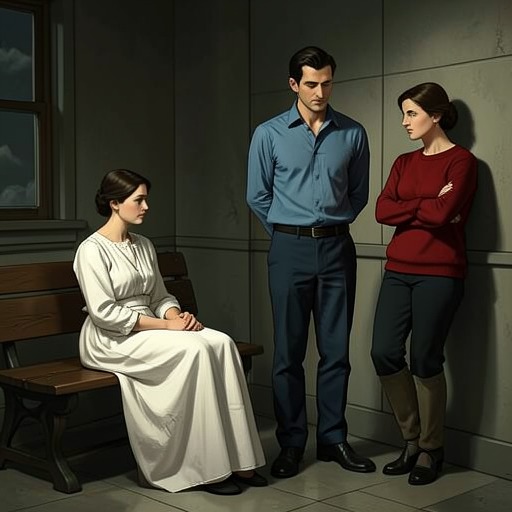
Laura Blacklock–Ben Howard relationship
The Woman in Cabin 10The relationship between Laura Blacklock and Ben Howard is defined by a painful split between what Laura remembers of their history and what she can trust about him in the present. Her accumulated anger at his dismissiveness helps turn suspicion into apparent certainty when she believes he may be involved in a murder. After Laura disappears, Ben’s efforts to find out what happened complicate that judgment: the man she had accused of complicity is also the person who insists that her disappearance must be taken seriously.
A History of Hurt and Distrust
Laura’s account of the relationship reaches back over many years. She remembers Ben as someone who belittled her feelings, a pattern that remains consequential even when she is alone and trying to interpret events aboard the ship. His conduct has left her with genuine grievance, not merely a misunderstanding that can be set aside once new facts emerge.
That history shapes how Laura weighs his actions. She is angry that Ben disclosed information to Johann Nilsson instead of supporting her account. The disclosure contributes to her sense that Ben has exposed or undermined her at a moment when she wanted him to believe her. At the same time, Laura later recognizes that her resentment was part of what made her too ready to suspect him. Her retrospective guilt does not erase his earlier behavior; it shows how their damaged trust makes the available evidence harder for her to read clearly.
Suspicion Aboard the Ship
Laura initially directs her attention toward Ben after Anne Bullmer mentions the possibility of a male accomplice. She interprets a derisive reaction to her question about who might be responsible as evidence that Ben could be involved. Later, while piecing together what she has seen and heard, she realizes she had not considered that Anne herself might have hurried down the spa stairs and written the threatening words while her nail varnish was meant to be drying. That possibility shifts the interpretation of the clue and makes Laura see that she had been too quick to judge Ben.
The correction is emotionally double-edged. Laura feels guilty for suspecting him, then angry that their history had made the suspicion feel so convincing. She specifically connects her readiness to blame him with his longstanding habit of belittling her feelings and his decision to tell Nilsson about her story rather than stand by her. The scene therefore does not present her change of mind as proof that her grievances were unfounded. Instead, it separates two questions she had conflated: whether Ben had hurt her and whether he had committed a murder.
Estrangement and Laura’s Disappearance
When Laura is no longer on the ship, she considers whether Ben might notice that her absence is out of character and contact her partner, Judah Lewis, or her parents. She thinks that under ordinary circumstances he probably would. But the circumstances between them are no longer ordinary: she has effectively accused him of complicity in murder, and he has reason to be angry. Laura fears he might interpret her unexplained departure as another rupture rather than as a sign that she is in danger.
That calculation reveals the practical cost of their broken trust. Laura is not simply unsure whether Ben cares; she is unsure whether their latest confrontation has made him less likely to act on concern. With other passengers unlikely to raise questions and with her own return to the ship uncertain, she cannot safely rely on him. She concludes that she must take matters into her own hands. Her fear is grounded in the damaged relationship, even though events later show that Ben did try to get help.
Ben’s Alarm and Laura’s Reassessment
After Laura fails to return home, Ben contacts Judah from Bergen to find out whether she has arrived. When Judah says he has heard nothing from her since Sunday, Ben urges him to contact the British police and report the disappearance as urgent. Judah later tells Laura that Ben had been raising the alarm since Trondheim, but that no one among the crew would listen to him. This account directly unsettles Laura’s earlier assumption that Ben might accept or ignore her disappearance.
Ben’s concern does not make their relationship easy to resolve. Judah also tells Laura that Ben gave a poor interview to the Mail, making it sound as if the breakup had been very recent, and describes him as self-important. Laura responds with a shaky laugh, saying the report makes her feel somewhat better about having accused him of murder. The humor allows a moment of relief, but it does not amount to reconciliation or establish that the past hurts have been repaired. It registers a narrower change: Laura can now acknowledge that she misjudged Ben’s actions in the crisis.
Significance and Unresolved Tension
The relationship functions as one of the story’s tests of Laura’s interpretation under pressure. Her suspicions are not detached from the past: Ben’s earlier treatment of her and his disclosure to Nilsson provide reasons for distrust, while also coloring how she reads ambiguous evidence. The later account of his efforts from Bergen corrects her belief that he would simply let her disappear, without making his history of dismissing her feelings disappear with it.
Their connection therefore remains complicated rather than neatly repaired. Laura’s guilt recognizes the harm of accusing Ben without sufficient grounds; her anger preserves the reasons she had difficulty trusting him. His actions after her disappearance demonstrate concern in a concrete way, but the evidence does not show a renewed romance or a full resolution of their grievances. What changes is Laura’s understanding of the immediate crisis: Ben was not the murderer she feared, and, despite their estrangement, he was trying to make someone listen.